
 Then (1905) vs Now (2026)
Black Swan or Paradigm Shifting
by Bart Binning, Ed. D.
” Rotary started with the vision of one man — Paul Harris. The Chicago attorney formed the Rotary Club of Chicago on 23 February 1905, so professionals with diverse backgrounds could exchange ideas and form meaningful, lifelong friendships.” (https://www.rotary.org/en/about-rotary/history)
This article (or outline) examines the similarities in the US in 1905, when Rotary was started, and today. Challenges to the labor market caused by technological innovation, increased productivity, pandemic and immigration were factors both then and now. Of the surface it may seem that the French journalist Alphonse Karr may be correct when he said in 1849 “The more things change, the more they are the same”. But…..
In 1905 the US was in the middle of the Progressive Era (typically 1890 to 1920) characterized by:
- Rapid industrial growth which led to significant changes in the labor market
- Transformation of the economy from horse-power to mechanization led to the transition from agrarian to manufacturing economies, which led to the rapid growth of cities, and social mobility
- Transformation of communication from print to electronic (from one-way, one-to-many to broadcast two-way)
- Increased productivity led to Henry Ford popularizing the 5-day, 40-hour work week in 1926
- Immigration: by 1905 the Federal Government consolidated control over inspections and admissions to the country
- The U.S. was experiencing increased immigration for the era (peak in 1907 of 1.3 million out of an estimated 87 million people, about 13% of the citizens were foreign born), particularly from Southern and Eastern Europe, raising debates about assimilation, labor competition, and national identity.
- Following the assassination of President McKinley the Anarchist Exclusion Act of 1903 – for the first time barred anarchists and other radicals from entering the country and allowed deportation based on political beliefs, not just actions.
- In 1904 SCOTUS ruled in Turner v Williams that non-citizens seeking entry into the US did not have constitutional rights to challenge their exclusion
- Economic inequality and monopoly
- Growing support for antitrust regulation (ex. Standard Oil, Carnegie/US Steel) – Clayton Antitrust Act (1914) strengthened the Sherman Act (1890) by addressing specific practices that harmed competition, such as price
- Federal Reserve system was established in 1913
- GDP per capita ~ $550
- Political Corruption
- Cronyism, political machines in cities, and graft
- Ratification of 17th amendment in 1913 leading to direct election of US Senators
- Social Justice and Progressive Reform
- women’s suffrage, temperance, education reforms, and public health
- reducing urban poverty, improving sanitation
- SCOTUS in 1896 had decided Plessy v. Ferguson which upheld segregation and constitutional
- addressing immigration
- Health and Epidemics
- Infectious diseases such as tuberculosis and typhoid
- Limited medical interventions
- Spanish Flu Pandemic from 1918 – 1920 killed about 670,000 people in the US
- Urbanization Challenges
- The primary challenge was the rapid growth of cities due to increase productivity of agriculture, which led to overcrowding, inadequate sanitation, and high death rates due to poor hygiene.
- Rapid migration to cities created concerns over overcrowding, housing quality, and urban infrastructure
On March 11. 2020, at an Oklahoma City Thunder Basketball game against the Utah Jazz, a Utah player tested positive for COVID 19. Shortly before the game was scheduled to begin, the game was suspended. Within hours of the game suspension, the NBA announced it was suspending the entire season indefinitely. This triggered one of the most pronounced economic events since the Great Depression. By the end of 2021, the COVID pandemic was considered to be over.
The period after the COVID-19 Pandemic (post 2022) is considered by many to the AI Era.
The AI Era may be classified as a Black Swan event; a term first coined by the 2nd Century Roman Poet Juvenal and popularized by Nassim Nicholas Taleb in his 2010 business book. The period may also be considered to mark a Paradigm Shifting event (a fundamental change in the way people think, understand, a field, replacing an existing framework with a new one; popularized by Thomas Kuhn in 2010) characterized by:
- Shifting to Industrial AI development from Academia, which has shifted the economy to rapidly growing patterns for AI based jobs and professions, contraction of back-office jobs due to productivity, as well as requiring new infrastructure to support changing demands.
- Rapid technological growth which is leading to significant changes in the labor market:
- Generative AI tools are reactive to user input whose purpose is to create human-like outputs (text, images, audio, video or code) based on patterns learned from historical data, and are transforming industries by enhancing productivity and quality
- Agentic AI tools are proactive or self-learning AI tools designed for autonomous action, performing multi-step tasks and workflows, by planning, reasoning, and acting toward a defined goal. Agentic tools can initiate actions, use tools and APIs (application Program Interfaces), and adjust strategies based on real-time context.
- The 4-day workweek is gaining momentum in the US as companies seek to increase productivity, improve employee well-being, and attract talent while reducing burnout and absenteeism. (https://www.apa.org/monitor/2025/01/rise-of-4-day-workweek)
- Immigration:
- For Fiscal Year 2025 US immigration quotas and limits include
- 226,000 family-sponsored,
- 150,000 employment-based
- 65,000 H1B plus 20,000 for advanced degrees
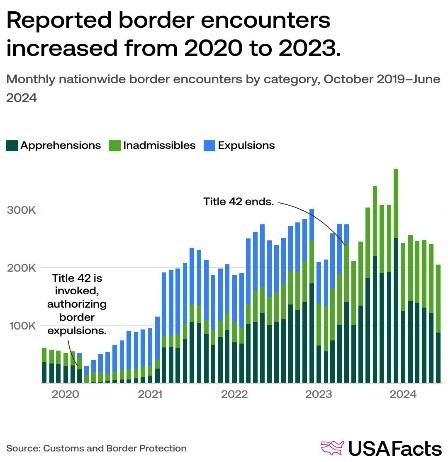
- Border officials encountered 11 million unauthorized migrants attempting to enter the US between October 2019 and June 2024
- The government’s January 2025 Current Population Survey shows the foreign-born or immigrant population (legal and illegal together) hit 53.3 million and 15.8 percent of the total U.S. population (https://cis.org/Report/ForeignBorn-Number-and-Share-US-Population-AllTime-Highs-January-2025)
- Economic inequality and monopoly
- Services dominate the economy (~70%), technology is rapidly growing, with manufacturing and agriculture less dominant but more technologically advanced.
- Concentration of medical resources in Hospitals and Health Insurance companies
- GDP per capita $58,440
- Political Corruption
- Megadonors dominate election spending, shaping policy through outsized influence.
- a shift from transactional corruption (cash bribes, patronage jobs, machine bosses) to structural corruption (influence networks, weakened oversight, and concentrated political spending), where the rules and institutions meant to prevent abuse are themselves weakened.
- Social Justice and Progressive Reform
- reducing urban poverty, improving sanitation and health care,
- Addressing immigration
- By 2025 congress had passed Civil Rights act of 1964, Voting Rights act of 1965. And SCOTUS had overturned Plessy v Ferguson in Brown v Board of Education of Topeka (1954)
- Civil Rights now encompasses “AI Bias”, digital privacy and LGBTQ+
- There is a growing movement against Diversity, Equity and Inclusion programs
- Health and Epidemics
- Infectious diseases such as COVID,
- Limited medical interventions such as gene splicing,
- It is estimated that from 2020 to the end of 2021 there were 846,729 deaths due to COVID in the US
- Urbanization Challenges
- With the migration to cities creating concerns over overcrowding, housing quality, and urban infrastructure are a concern
- With the overcrowding of the cities, and advances in telecommunication, there is more demand for suburban living, away from the city center toward less densely populated areas.
! Rotary Article 43 Change vs The Same / With help from ChatGPT
There are no comments published yet.